Mostrar mensagens com a etiqueta Bobby Hutcherson. Mostrar todas as mensagens

quinta-feira, 3 de fevereiro de 2011

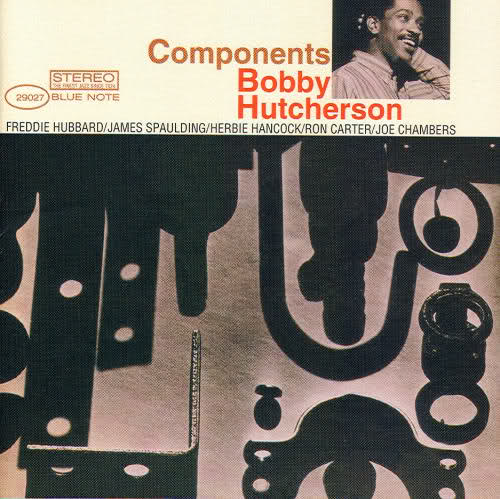
Bobby Hutcherson - Components (1965)

Perhaps the single album that best sums up Bobby Hutcherson's early musical personality, Components is appropriately split into two very distinct halves. The first features four Hutcherson originals in a melodic but still advanced hard bop style, while the latter half has four free-leaning avant-garde pieces by drummer Joe Chambers. Hutcherson allots himself more solo space than on Dialogue, but that's no knock on the excellent supporting cast, which includes Herbie Hancock on piano, James Spaulding on alto sax and flute, Freddie Hubbard on trumpet, and Ron Carter on bass. It's just more Hutcherson's date, and he helps unite the disparate halves with a cool-toned control that's apparent regardless of whether the material is way outside or more conventionally swinging. In the latter case, Hutcherson's originals are fairly diverse, encompassing rhythmically complex hard bop (the title track), pensive balladry ("Tranquillity," which features a lovely solo by Hancock), down-and-dirty swing ("West 22nd Street Theme"), and the gaily innocent "Little B's Poem," which went on to become one of Hutcherson's signature tunes and contains some lyrical flute work from Spaulding. The Chambers pieces tend to be deliberate explorations that emphasize texture and group interaction in the manner of Dialogue, except that there's even more freedom in terms of both structure and tonal center. (The exception is the brief but beautiful closing number, "Pastoral," an accurate title if ever there was one.) Components illustrated that Hutcherson was not only the most adventurous vibes player on the scene, but that he was also capable of playing more straightforward music with intelligence and feeling.
by Steve Huey in All Music Guide

Styles:
Modal
Post-Bop

Tracks:
01 - Components (06:23)
02 - Tranquility (05:01)
03 - Little B's Poem (05:08)
04 - West 22nd Street Theme (04:42)
05 - Movement (07:29)
06 - Juba Dance (05:21)
07 - Air (04:45)
08 - Pastoral (02:02)

Line-up:
Bobby Hutcherson: vibraphone
Joe Chambers: drums
Herbie Hancock: piano
James Spaulding: alto saxophone, flute
Freddie Hubbard: trumpet
Ron Carter: bass

terça-feira, 1 de fevereiro de 2011

Eric Dolphy - Iron Man (1963)

The companion piece to Conversations (recorded at the same mid-1963 sessions with producer Alan Douglas), Iron Man is every bit as essential and strikes a more consistent ambience than its widely varied twin. It also more clearly anticipates the detailed, abstract sound paintings of Dolphy's masterwork Out to Lunch, in large part because this time around the program is weighted toward Dolphy originals. "Iron Man," "Burning Spear," and the shorter "Mandrake" all have pretty outside themes, full of Dolphy's trademark wide interval leaps and playful sense of dissonance. Yet there's enough structure and swing to make their roots in hard bop perfectly clear, and once the front-line horns blast out the themes, the ensemble shifts into a more cerebral, exploratory mode. In the absence of a piano, Bobby Hutcherson's vibes are a crucial anchor, outlining dissonant harmonies that hang in the air almost spectrally behind the rest of the group. Most of the same musicians from Conversations appear here, including trumpeter Woody Shaw, flutist Prince Lasha, altoist Sonny Simmons, and soprano sax player Clifford Jordan. And once again, Dolphy duets with bassist Richard Davis, twice this time -- on bass clarinet for Ellington's "Come Sunday" and on flute for Jaki Byard's "Ode to C.P." Both are lovely, meditative pieces filled with conversational exchanges between the two players, illustrating what similar wavelengths they were on. Between Conversations and Iron Man, split up the way they are, one has to give a slight edge to the latter for its more cohesive presentation, yet these are classic sessions in any form and constitute some of the most brilliant work of the early-'60s avant-garde.
by Steve Huey in All Music Guide

Styles:
Avant-Garde
Free-Jazz
Post-Bop

Tracks:
01 - Iron Man (09:07)
02 - Mandrake (04:50)
03 - Come Sunday (06:24)
04 - Burning Spear (11:49)
05 - Ode to C.P. (08:05)

Line-up:
Eric Dolphy – bass clarinet, flute, alto saxophone
Richard Davis – bass
Clifford Jordan – tenor saxophone
Sonny Simmons – alto saxophone
(William) Prince Lasha – flute
Woody Shaw Jr. – trumpet
Bobby Hutcherson – vibraphone
J.C. Moses – drums
Eddie Khan – bass ("Iron Man")

quarta-feira, 3 de novembro de 2010

Bobby Hutcherson - Dialogue (1965)

Coming fresh on the heels of his groundbreaking work with Eric Dolphy, Bobby Hutcherson's debut album is a masterpiece of "new thing" avant-garde jazz, not really free but way beyond standard hard bop. Dialogue boasts an all-star lineup of hot young post-boppers -- trumpeter Freddie Hubbard, woodwind player Sam Rivers, pianist Andrew Hill, bassist Richard Davis, and drummer Joe Chambers -- and a set of imaginative compositions by either Hill or Chambers that frequently push the ensemble into uncharted territory. The result is an album bursting at the seams with ideas that still sound remarkably fresh, not to mention a strong sense of collectivity. Hutcherson has so many fine players on hand that the focus is naturally on group interaction rather than any particular soloist(s), setting up nice contrasts like the fiery sax work of Rivers versus the cooler tones of Hutcherson and Hill. Hill's pieces stand tradition on its head, twisting recognizable foundations like the blues ("Ghetto Lights"), Latin jazz ("Catta"), and marching bands ("Les Noirs Marchant," which sounds like a parade of mutant soldiers) into cerebral, angular shapes. Chambers, meanwhile, contributes the most loosely structured pieces in his delicate, softly mysterious ballad "Idle While" and the nearly free group conversations of the ten-minute title track, where Hutcherson also plays the more African-sounding marimba. What's impressive is how focused Hutcherson keeps the group through those widely varied sounds; no one is shortchanged, yet the solos are tight, with no wasted space or spotlight-hogging. Dialogue remains Hutcherson's most adventurous, "outside" album, and while there are more extensive showcases for his playing, this high-caliber session stands as arguably his greatest musical achievement.
by Steve Huey in All Music Guide

Styles:
Hard-Bop
Post-Bop

Tracks:
01 - Catta (07:19)
02 - Idle While (06:37)
03 - Les Noirs Marchant (06:41)
04 - Dialogue (09:59)
05 - Ghetto Lights (06:16)
06 - Jasper (08:29)

Line-up:
Bobby Hutcherson: vibraphone, marimba
Joe Chambers: drums
Andrew Hill: piano
Sam Rivers: woodwinds
Freddie Hubbard: trumpet
Richard Davis: bass

terça-feira, 27 de abril de 2010

Eric Dolphy - Out to Lunch (1964)

Out to Lunch stands as Eric Dolphy's magnum opus, an absolute pinnacle of avant-garde jazz in any form or era. Its rhythmic complexity was perhaps unrivaled since Dave Brubeck's Time Out, and its five Dolphy originals -- the jarring Monk tribute "Hat and Beard," the aptly titled "Something Sweet, Something Tender," the weirdly jaunty flute showcase "Gazzelloni," the militaristic title track, the drunken lurch of "Straight Up and Down" -- were a perfect balance of structured frameworks, carefully calibrated timbres, and generous individual freedom. Much has been written about Dolphy's odd time signatures, wide-interval leaps, and flirtations with atonality. And those preoccupations reach their peak on Out to Lunch, which is less rooted in bop tradition than anything Dolphy had ever done. But that sort of analytical description simply doesn't do justice to the utterly alien effect of the album's jagged soundscapes. Dolphy uses those pet devices for their evocative power and unnerving hints of dementia, not some abstract intellectual exercise. His solos and themes aren't just angular and dissonant -- they're hugely so, with a definite playfulness that becomes more apparent with every listen. The whole ensemble -- trumpeter Freddie Hubbard, vibist Bobby Hutcherson, bassist Richard Davis, and drummer Tony Williams -- takes full advantage of the freedom Dolphy offers, but special mention has to be made of Hutcherson, who has fully perfected his pianoless accompaniment technique. His creepy, floating chords and quick stabs of dissonance anchor the album's texture, and he punctuates the soloists' lines at the least expected times, suggesting completely different pulses. Meanwhile, Dolphy's stuttering vocal-like effects and oddly placed pauses often make his bass clarinet lines sound like they're tripping over themselves. Just as the title Out to Lunch suggests, this is music that sounds like nothing so much as a mad gleam in its creator's eyes.
by Steve Huey in All Music Guide

Styles:
Post-bop
Avant-Garde

Tracks:
01 - Hat and Beard (8:28)
02 - Something Sweet, Something Tender (6:06)
03 - Gazzelloni (7:24)
04 - Out to Lunch (12:10)
05 - Straight Up and Down (8:21)Line-up:
Eric Dolphy - alto saxophone, flute, bass clarinet
Freddie Hubbard - trumpet
Bobby Hutcherson - vibraphone
Richard Davis - bass
Tony Williams - drums