Mostrar mensagens com a etiqueta James Spaulding. Mostrar todas as mensagens

quinta-feira, 3 de fevereiro de 2011

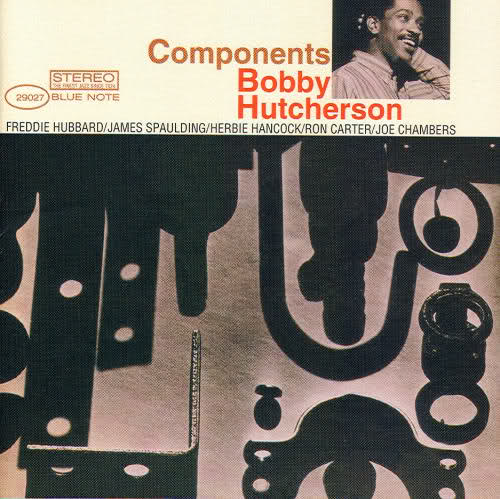
Bobby Hutcherson - Components (1965)

Perhaps the single album that best sums up Bobby Hutcherson's early musical personality, Components is appropriately split into two very distinct halves. The first features four Hutcherson originals in a melodic but still advanced hard bop style, while the latter half has four free-leaning avant-garde pieces by drummer Joe Chambers. Hutcherson allots himself more solo space than on Dialogue, but that's no knock on the excellent supporting cast, which includes Herbie Hancock on piano, James Spaulding on alto sax and flute, Freddie Hubbard on trumpet, and Ron Carter on bass. It's just more Hutcherson's date, and he helps unite the disparate halves with a cool-toned control that's apparent regardless of whether the material is way outside or more conventionally swinging. In the latter case, Hutcherson's originals are fairly diverse, encompassing rhythmically complex hard bop (the title track), pensive balladry ("Tranquillity," which features a lovely solo by Hancock), down-and-dirty swing ("West 22nd Street Theme"), and the gaily innocent "Little B's Poem," which went on to become one of Hutcherson's signature tunes and contains some lyrical flute work from Spaulding. The Chambers pieces tend to be deliberate explorations that emphasize texture and group interaction in the manner of Dialogue, except that there's even more freedom in terms of both structure and tonal center. (The exception is the brief but beautiful closing number, "Pastoral," an accurate title if ever there was one.) Components illustrated that Hutcherson was not only the most adventurous vibes player on the scene, but that he was also capable of playing more straightforward music with intelligence and feeling.
by Steve Huey in All Music Guide

Styles:
Modal
Post-Bop

Tracks:
01 - Components (06:23)
02 - Tranquility (05:01)
03 - Little B's Poem (05:08)
04 - West 22nd Street Theme (04:42)
05 - Movement (07:29)
06 - Juba Dance (05:21)
07 - Air (04:45)
08 - Pastoral (02:02)

Line-up:
Bobby Hutcherson: vibraphone
Joe Chambers: drums
Herbie Hancock: piano
James Spaulding: alto saxophone, flute
Freddie Hubbard: trumpet
Ron Carter: bass

quinta-feira, 1 de julho de 2010

Sam Rivers - Dimensions And Extensions (1967)

Ambitious, atonal, challenging -- all are accurate descriptions of Dimensions and Extensions, Sam Rivers' fourth album for Blue Note. Rivers remains grounded in hard bop structure, working with a sextet featuring Donald Byrd (trumpet), James Spaulding (alto saxophone, flute), Julian Priester (trombone), Cecil McBee (bass), and Steve Ellington (drums), but he explodes the boundaries of the form with difficult, dissonant compositions. With his unique, mercurial tone and edgy solos, he keeps pushing the sextet in different directions. It's intense, cerebral music, but since it has distinct themes and strong rhythms, the forays into free jazz, dissonant harmonies, and unpredictable tonal textures are actually quite accessible. Rivers simply burns on each track, whether playing tenor, soprano, or flute. Byrd doesn't display the wild imagination of Rivers, yet he keeps the pace with alternately languid and biting solos. Similarly, each of the remaining musicians makes a lasting impression with his individual time in the spotlight. With music as risky at this, it's forgivable that it occasionally meanders (especially on the slower numbers) but, overall, Dimensions and Extensions offers more proof that Sam Rivers was one of the early giants of the avant-garde.
by Stephen Thomas Erlewine in All Music Guide

Styles:
Post-Bop
Avant-Garde

Tracks:
01 - Precis (05:21)
02 - Paean (05:25)
03 - Effusive Melange (05:49)
04 - Involution (07:14)
05 - Afflatus (06:28)
06 - Helix (05:30)

Line-up:
Sam Rivers – Tenor Sax, Soprano Sax, Flute
James Spaulding – Alto Sax, Flute
Donald Byrd – Trumpet
Julian Priester – Trombone
Cecil McBee – Bass
Steve Ellington - Drums

quinta-feira, 10 de junho de 2010

Leon Thomas - Spirits Known and Unknown (1969)

Leon Thomas' debut solo recording after his tenure with Pharoah Sanders is a fine one. Teaming with a cast of musicians that includes bassist Cecil McBee, flutist James Spaulding, Roy Haynes, Lonnie Liston Smith, Richard Davis, and Sanders (listed here as "Little Rock"), etc. Thomas' patented yodel is in fine shape here, displayed alongside his singular lyric style and scat singing trademark. The set begins with a shorter, more lyrical version of Thomas' signature tune "The Creator Has a Master Plan," with the lyric riding easy and smooth alongside the yodel, which bubbles up only in the refrains. It's a different story on his own "One," with Davis' piano leading the charge and Spaulding blowing through the center of the track, Thomas alternates scatting and his moaning, yodeling, howling, across the lyrics, through them under them and in spite of them. It's an intense ride and one that sets up the glorious "Echoes." This tune is Thomas at his most spiritual and uplifting, carrying the mysterious drift of his tune entwined with Spaulding's flute and a set of Pan pipes, fluttering in and out of the mix before his wail comes to the fore as a solo. The end of side one reaches into Thomas' past (he sang with everyone from Count Basie to Grant Green and Mary Lou Williams) for a highly original read of Horace Silver's classic "Song for My Father." Thomas imbues the tune with so much emotion, it's a wonder he can keep it under wraps. Side two is more free from in nature with "Damn Nam," a near rant, but one possessed with melodic vision and harmonic invention with this band. There's also the deeply moving "Malcolm's Gone," a co-write between Thomas and Sanders that features the latter's gorgeous blowing, hard and true in the middle of the mix, and a wildly spiritual Eastern vibe coming through in the improvisation. It's the longest track on the record, and one of the most criminally ignored in Thomas' long career. The album closes with Bell and Houston's "Let the Rain Fall on Me." It's a shimmering straight jazz number with a beautiful piano solo by Smith. It sends out a visionary album out on a sweet, soulful note. Ultimately, this is among Thomas' finest moments on vinyl, proving his versatility and accessibility to an audience who, for too long already, had associated him too closely with the avant-garde and free jazz.

Styles:
Avant-Garde
Yodel
Progressive Jazz

Tracks:
01 - Creator Has a Master Plan (Peace) (04:27)
02 - One (03:10)
03 - Echoes (05:42)
04 - Song For My Father (05:21)
05 - Damn Nam (Ain't Going to Vietnam) (04:46)
06 - Malcom's Gone (08:45)
07 - Let the Rain Fall on Me (05:39)
08 - Um, Um, Um (05:25)
09 - Night in Tunisia (08:27)
10 - Take the A Train [Alternate Take #1] (02:15)
11 - Take the A Train [Alternate Take #2] (02:09)
12 - Take the A Train [Master Take] (02:08)
13 - Walkin [Alternate Take] (02:34)
14 - Walkin [Master Take] (02:32)
15 - Willow weep for Me [Alternate Take ] (02:40)
16 - Willow weep for Me [Master Take] (02:34)
17 - If It Didn't Hurt So Much [Alternate Take] (02:41)
18 - If It Didn't Hurt So Much [Master Take] (02:35)

Line-up:
Leon Thomas - vocals
Lonnie Liston Smith - piano
James Spaulding - alto sax
Pharoah Sanders - tenor sax
Cecil McBee - bass
Richard Davis - bass
Roy Haynes - drums
Richard Landrum - bongos

quinta-feira, 29 de abril de 2010

Pharoah Sanders - Karma (1969)

John Coltrane left behind a legacy of experimental and extremely spiritual work whose timeless quality still reverberates today. After his untimely death many poseurs came out to stake their claim as the next Coltrane. Many tried and many failed. Then in 1969 a former sideman of Coltrane's, Pharoah Sanders, stepped out from the shadow of his mentor and recorded Karma, which bore the soul of Coltrane's musical and spiritual passion.
Karma was released four years after his first record as a leader, Pharoah's First (1965). While working with Coltrane, Sanders began to develop an aggressive tone that ripped into an anarchaotic passion owing as much to Coltrane as Albert Ayler. His records as a leader did not always reflect the raw energy that would show up on Coltrane classics such as Ascension. His 1966 Impulse! debut, Tauhid, is a great example of this. Sanders let the work take on a generalized groove that worked with the mood created in each piece. In doing so, he created not only his best pre-Karma record, but one of his finest overall. After Coltrane's death, Pharoah worked with his widow Alice before setting to work on what would become Karma.
As with many records of the mid to late-'60s/early '70s, Karma is based primarily around the first of two album tracks, "The Creator Has a Master Plan." The track is one of the finest and best-executed and edited jams ever caught on record, though many critics would and will argue with that statement. The master plan of tracks on contemporaneous Miles Davis records like In a Silent Way or Bitches Brew was created by the editing and production efforts of Teo Maceo. Recordings like Free Jazz or Ascension, in contrast, worked by virtue of the way they tore down sonic and musical boundaries. Sanders incorporates these values into "The Creator," making it more than just a loose jam; no matter where Sanders goes, he is in total control. Even as the piece peaks into volatile eruptions roughly sixteen minutes in, he saddles the passion and works the track back into the initial groove that was comprised its first movement.
"Creator" comes in at 32:47 and wastes not a single note. Opening with a virtual rush of sound, it then quiets down and drops a brief riff from A Love Supreme. The tune then works itself into a groove that would later be known as acid jazz, working with Eastern percussion and allowing the bass to float close to the front of the mix. This first section relies on a modal two-chord structure that keeps the tone bouncy and meditative. At eight minutes Leon Thomas begins a chant-like vocal that varies lines from the mantra "The creator has a master plan, peace and love for every man." The vocals drop and the third movement becomes an unrelenting Coltranesque blitz that tears the mellow mood apart, only to combine the angst and mellowness in the next movement and settle back into a reprise of the first fourteen minutes.
"Colors," on the other hand, is a shorter and more structured piece that features some solid and well-executed chops. Again Leon Thomas sings, and Ron Carter takes over the duties of Richard Davis and Reggie Workman.
Love or hate the music of Pharoah Sanders, you cannot deny the man's vision after hearing this record. His is an absolute genius approach to arrangement and performance. Though Sanders would release many great records and even mellow his distinctive tenor sound down, Karma is a record that deserves to be heard by any serious jazz fan.
by Trevor McLaren in All About Jazz

Styles:
Progressive Jazz
Modal
Post-bop
Avant-Garde
Free-Jazz

Tracks:
01 - The Creator Has a Master Plan (32:47)
02 - Colors (05:36)

Line-up:
Pharoah Sanders - Sax (Tenor)
Leon Thomas - Percussion / Vocals
Julius Watkins - French Horn
James Spaulding - Flute (on track 1)
Lonnie Liston Smith - Piano
Reggie Workman - Bass
Richard Davis - Bass (on track 1)
Ron Carter - Bass (on track 2)
Billy Hart - Drums (on track 1)
Freddie Waits - Drums (on track 2)
Nathaniel Bettis - Percussion (on track 1)
Leon Thomas - Vocals